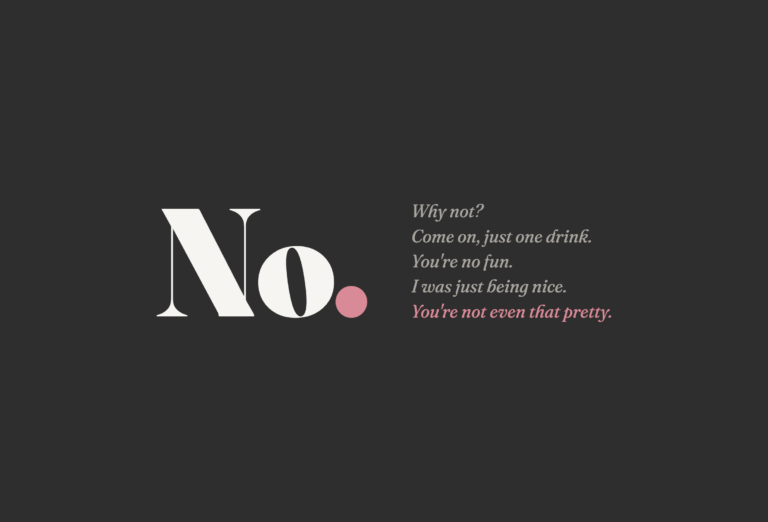
Conflict is everywhere right now
I have been thinking about conflict a lot lately. I live in a part of the world where people are taking to the streets, angry and loud, demanding to be heard. At home, my partner and I are in a season of butting heads, the way long relationships sometimes are. At work, I am building big projects with friends, which means for the first time I am learning what it looks like when a friendship becomes a working relationship too.
And I keep crossing paths with people I have had conflict with in the past. Each time, I ask myself the same question: how do I show up as myself, fully, without shrinking and without performing?
What I keep landing on is this. Directness is a form of respect while avoidance as a form of self-protection is something we have learned to call kindness.
I am not aggressive. I am direct.
I have always had a reputation for being harsh. Years ago, in a sorority that practiced initiation, I was asked to be the disciplinarian or the “mean” one. I said yes, because that was the role they handed me. In reflection, I realize that I accepted this role as a form of protection as well, if I was viewed as mean, I wouldn’t have to deal with people expressing their problems with me to me (more on that in a bit).
In reality, I am not an aggressive person. I also understand why the world sometimes reads me that way. I am tall, I have a strong body, I communicate directly saying exactly what I mean. My cultural background is often labeled as angry or “fiery”. Put that together, and people often decide what I mean before I finish my sentence.
Here is the difference as I understand it, aggression aims to dominate or to harm and directness aims to be understood. But the label is rarely assigned by intent. It is assigned by how a body, a voice and a background get read. A small, soft-spoken woman says the same sentence I say, and she is called honest.
The cruelty is that women like me are often recruited into performing the very trait we are later punished for. The group needed an enforcer, chose the woman who looked the part, and then remembered her as the mean one.
Conflict as care
I am comfortable telling people how they hurt me (sometimes). I am comfortable naming when someone has operated, in business or in life, in a way that does not align with my values. I’ve worked on this and I proudly speak up and defend myself and others.
The hard part is the other direction. This is what I avoided by accepting the mean label. Hearing what I have done wrong is uncomfortable. I hate it. My first instinct is to defend and to deny. But I have learned to sit with it (thanks meditation), to think about what I did, and to admit where I fall short (hate this part too).
Recently I have been working with one of my best friends, and we have both had to take hard looks at how we show up. She told me how I made her feel (shitty). I tried to understand it instead of explaining it away (ugh so uncomfortable). I told her how she made me feel, and she did the same. Our friendship is stronger because of this, we name the conflict, we change, we adapt, and we get stronger together. I feel safe with her.
That is the opposite of what most of us were taught. We learned that conflict damages relationships. In my experience, avoidance damages them more. Conflict and friction are normal, healthy parts of life. Direct conflict, offered with care, treats them as capable of growth instead of avoidance which might be treating as if people are too fragile or not worth the truth. Writers like Sarah Schulman in Conflict Is Not Abuse and Ddrienne Maree Brown in We Will Not Cancel Us make versions of this case: that we need to get better at staying in hard conversations rather than escaping them.
Where the backbiting comes from
I keep thinking about how often women, in particular, talk about each other behind closed doors instead of speaking directly. This I believe it is a learned survival strategy, and it has a history.
The educator Paulo Freire wrote about how oppressed people often turn on each other, absorbing the oppressor’s view of themselves and of their peers. This is sometimes called horizontal or lateral hostility. Instead of pushing up against the system, we push sideways against the people next to us, we push down on the people who we can.
Bell Hooks wrote that patriarchy teaches women to see one another as rivals, and that real sisterhood has to be built deliberately, as political solidarity, because it will not appear on its own. We have to be better at being intentional about creating safe spaces together.
We are not each other’s competition, even if it feels that way. We belong to a gender that is still being taken advantage of, when we compete with each other, the system wins.
In the United States especially, this pattern is tied to a history of colonization and slavery. When women held power, it was often power over other women. When those who feel powerless are given someone they are “above” we can see cruelties at a whole new level, it’s becomes a way to get out the shame and anger at how they are treated and finally feel in control. Historian Stephanie Jones-Rogers, in They Were Her Property, documents how white women in the South owned, managed and brutalized enslaved people, women included. They were not bystanders at all, they held other women’s safety and survival in their hands.
In a structure like that, proximity to power becomes a survival skill. Telling on someone, talking about someone, positioning yourself as superior to another woman, could earn favor from the people at the top. Gossip and mean-spirited comments became a way to get closer to the powerful. Many women chose that proximity over the collective, and many of us are still living out the habits it left behind.
Not all talk is betrayal
Still, not every whispered conversation is the same. My training is in anthropology, and that field has long recognized that gossip does more than one thing. Political scientist James Scott described the everyday tools available to people without formal power, the “weapons of the weak,” and talk was one of them. Whisper networks have protected women from predatory men for generations. The #MeToo movement was, in part, a whisper network going public.
So the line I draw is between two kinds of talk:
- Talk that seeks favor with power: telling on someone, cutting someone down, to get closer to the top.
- Talk that protects the vulnerable: warning each other because direct confrontation is not yet safe.
That distinction matters, because for many women directness has been genuinely dangerous. Speaking up has cost people their jobs, their safety and their standing. I do not want to shame anyone for surviving, what I want is to build relationships and spaces where directness is safe enough to choose.
The tension I sit with
Being right about the stereotype does not mean every “harsh” label I have received was only projection. Directness has a delivery, a timing and a position of power. The same true sentence lands differently from a supervisor than from a peer and it lands differently in a heated moment than in a calm one. I’m learning in realtime how to use my directness in the right way, and I’ve caused harm. Growth, for me, lives in being able to tell the difference, and in being willing to look.
Showing up as myself
The people in the streets, my partner and I at the kitchen table, my best friend and I across a project plan: we are all being asked the same question. Can we stay in the discomfort long enough for something to change? Showing up authentically might simply mean being the same person in that room that I am everywhere else, no performed warmth, no performed coldness. Just me.
I believe we can. I believe the women who learned to whisper can learn to speak plainly to each other, and to hear each other plainly too. When we stop competing for proximity to power, we start building power together. Conflict, held with care, is not what breaks us, it is how we find out what we are made of.
*I used an AI writing tool to check grammar and clarity. The ideas, experiences, and writing are my own.
References
brown, adrienne maree. We Will Not Cancel Us: And Other Dreams of Transformative Justice. Chico, CA: AK Press, 2020.
Freire, Paulo. Pedagogy of the Oppressed. Translated by Myra Bergman Ramos. New York: Herder and Herder, 1970.
hooks, bell. “Sisterhood: Political Solidarity Between Women.” In Feminist Theory: From Margin to Center. Boston: South End Press, 1984.
Jones-Rogers, Stephanie E. They Were Her Property: White Women as Slave Owners in the American South. New Haven: Yale University Press, 2019.
Kennedy, Florynce. “Institutionalized Oppression vs. the Female.” In Sisterhood Is Powerful, edited by Robin Morgan. New York: Random House, 1970. (Source of the term “horizontal hostility.”)
Lorde, Audre. “The Master’s Tools Will Never Dismantle the Master’s House” and “The Uses of Anger: Women Responding to Racism.” In Sister Outsider: Essays and Speeches. Trumansburg, NY: Crossing Press, 1984.
Schulman, Sarah. Conflict Is Not Abuse: Overstating Harm, Community Responsibility, and the Duty of Repair. Vancouver: Arsenal Pulp Press, 2016.
Scott, James C. Weapons of the Weak: Everyday Forms of Peasant Resistance. New Haven: Yale University Press, 1985.